
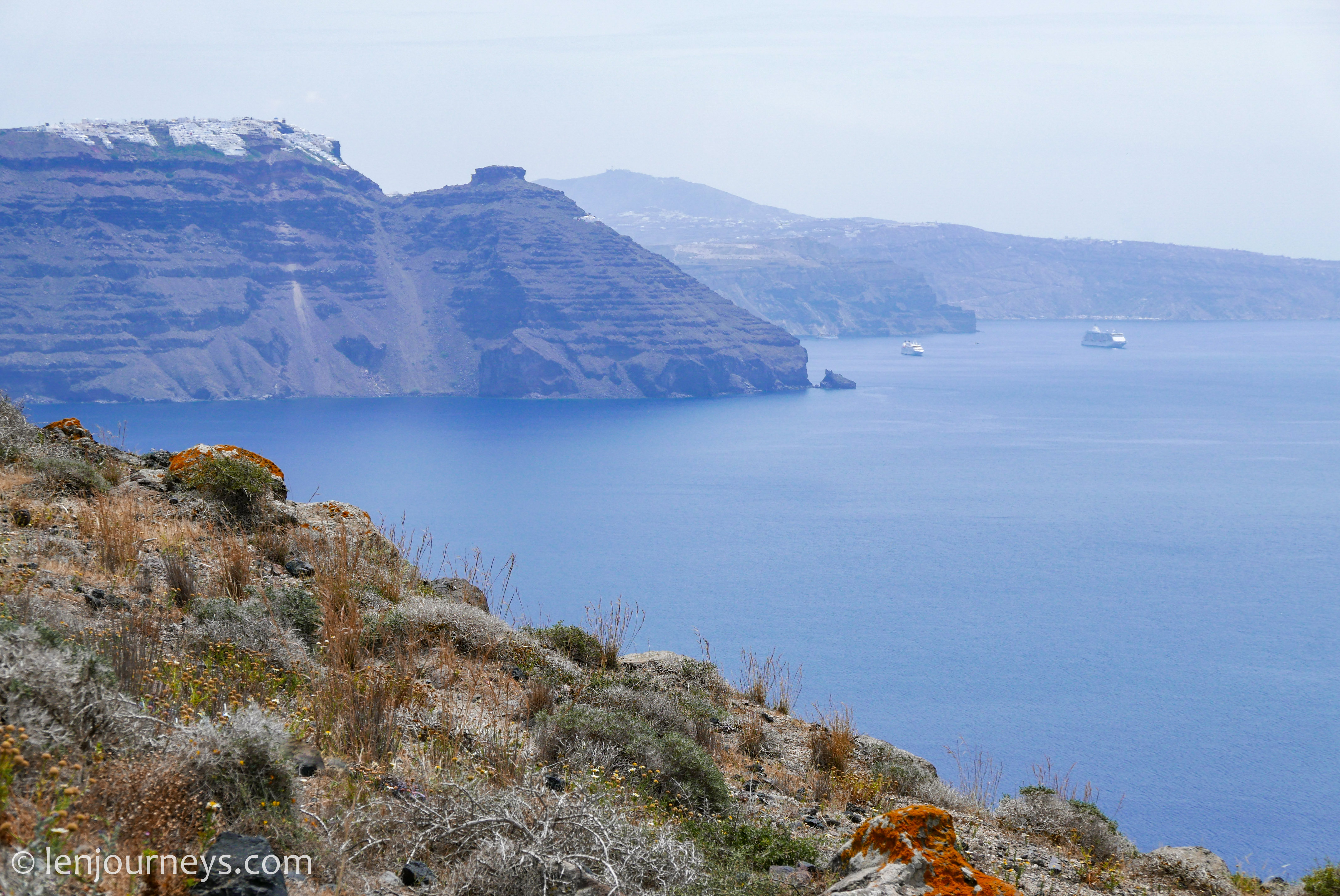
Stretching for about ten kilometers, the path from Fira to Oia is undoubtedly one of the most popular trails in Santorini. It winds through the island’s charming villages and offers a picturesque vista over the vast, crescent-shaped caldera.
Santorini, that name alone, evokes images of perfect sunsets, whitewashed villages cascading down the cliffs, and an idyllic island life. But by a closer examination, one can easily recognize the traces of devastation still edged on the rocks. They glow in rusty red, yellow, white, and black under the sun, which contrast sharply with the azure waters below.
To fully grasp this austere beauty of Santorini, there is no better way than walking along its steep-walled caldera. Starting from Fira – the island’s capital, the cobblestoned path runs north, through Firostefani, Imerogvigli, before ending at the famous village of Oia. On the way, visitors can enjoy some of the best views over the crescent-shaped caldera and have a sense of devastation caused by past eruptions.
The Caldera of Santorini
Santorini, officially known as Thira, is the remnant of a volcanic island in the Aegean Sea. Over 3600 years ago, a massive volcanic eruption blew up this island, permanently altering the Mediterranean topography. It was unlike anything recorded in human history, reputedly wiping out Minoan settlements in Crete and inspiring Plato’s myth of Atlantis. The explosion caused the sides and top of the volcano to collapse into itself, before being submerged under the sea.
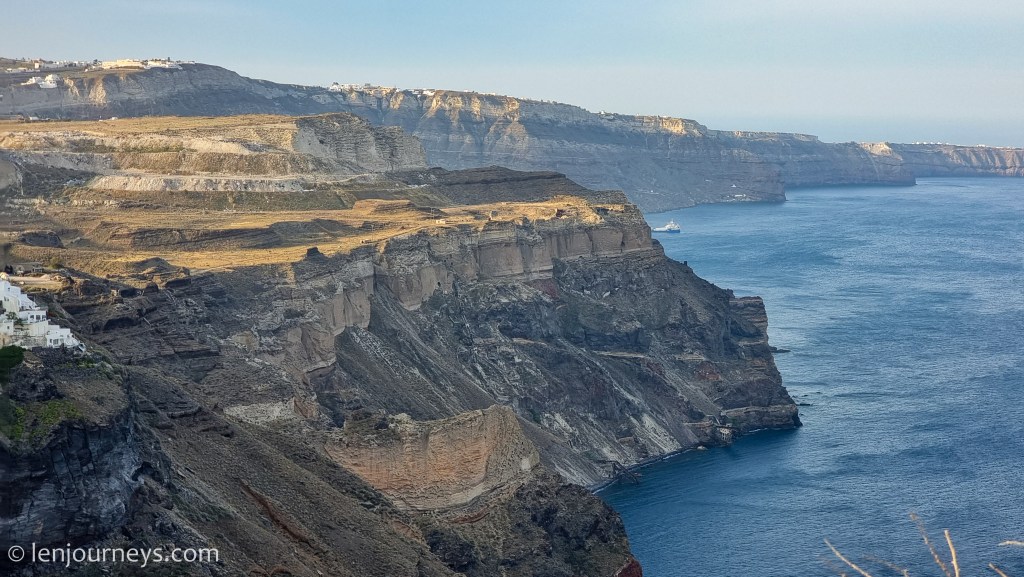
A circular archipelago was subsequently formed, with the largest fragment becoming what is now Santorini. Its rim is uneven, with the height varying from 150 to 350 meters. At the center of the caldera bay is a “new” volcanic island – the Nea Kameni – which occasionally causes trouble. The most recent eruption was in 1950 which deserted the island for many years. Despite all these, the locals have never given up and the white cliff-top villages are fine examples of their endurance.

1. Fira and Firostefani
Located opposite the volcanic island of Nea Kameni, Fira is Santorini’s largest settlement and its capital. The town features pristine white cliff-top houses punctuated with blue cupolas. It’s here that all the action takes place, with a great selection for dining, shopping, and entertainment. It’s also the end point of Karavolades Stairs, or the Old Harbor Trail, which connects to the former nautical haven through 588 steps. These days, donkeys still transport goods up and down this stairway.
A few kilometers northward is Firostefani. Though being considered a separate settlement, the village is, in fact, an extension of Fira. Its name means “Crown of Fira”, indicating its position on the upper part of the capital. Firostefani has narrow, quaint paths with cozy restaurants, charming hotels, and boutiques. But the atmosphere is markedly less frantic than the main streets of Fira. And because of the proximity to the capital, visitors can have the best of both worlds here: serenity of a village but access to a vibrant nightlife.




2. Imerovigli
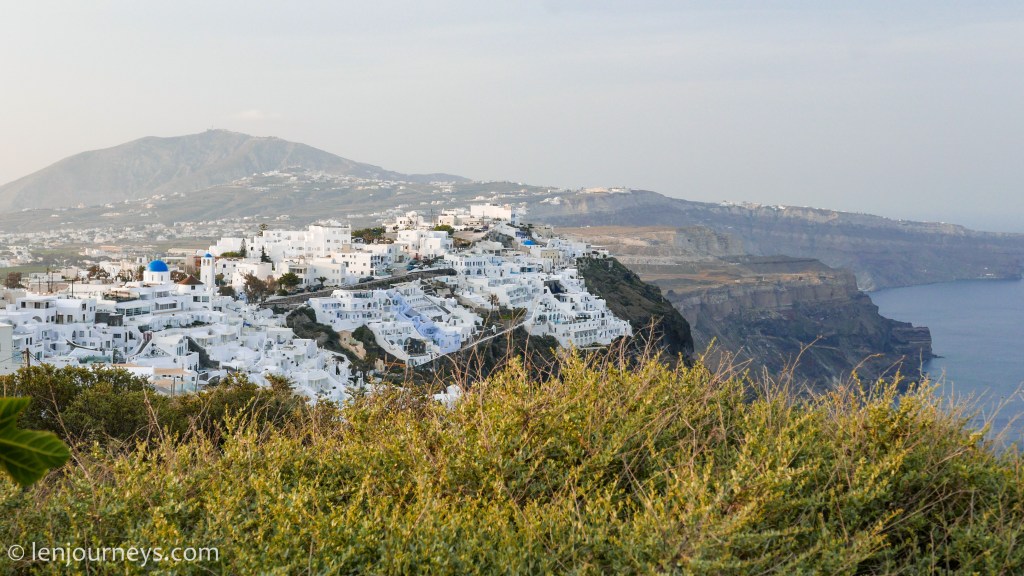
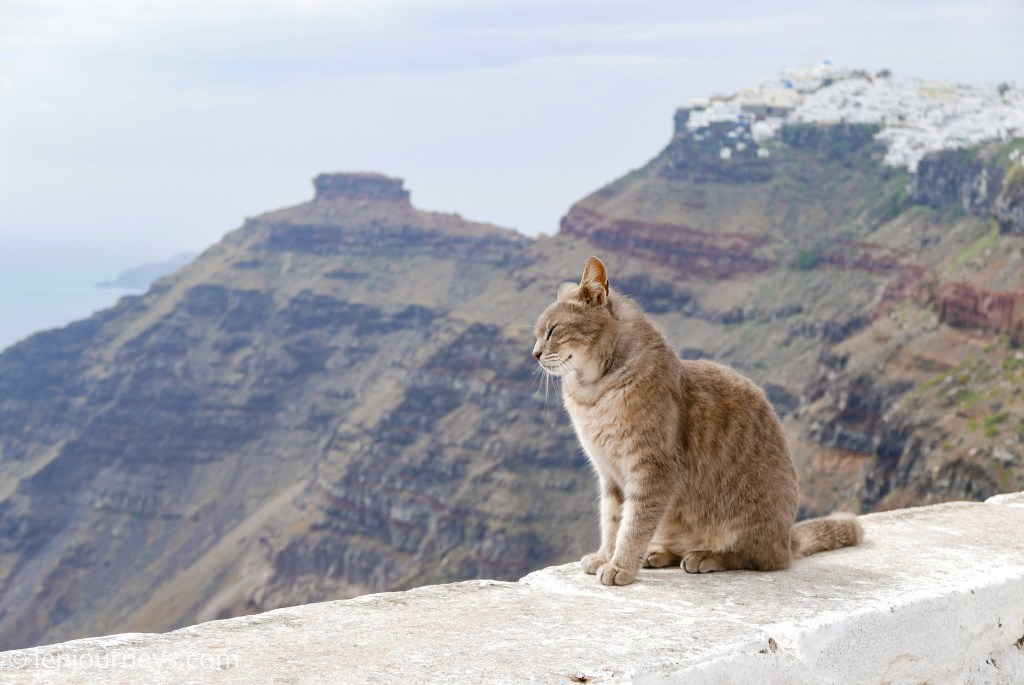
Perched on a 350-meter-high cliff, Imerovigli offers even greater vistas of the caldera bay. It lies on the highest point of the rim and was once a lookout post providing security from pirates. Under Venetian rule, a stronghold was built on a red-hued rocky headland in front of the village, the Skaros Rock. It protrudes out to the sea and is one of Santorini’s most prominent fortresses. However, an earthquake in the early 19th century destroyed the structure.
These days, Imerovigli is renowned for its aesthetically pleasing appearance, with flower-draped houses and vibrant taverns lining peaceful cobblestone alleys. Many of them have become upscale boutique hotels and resorts. There are also numerous churches and chapels in the village, most notably Panagia Malteza and Panagia Theoskepasti which were built on the cliff edge, offering panoramic views over the caldera.


3. Oia
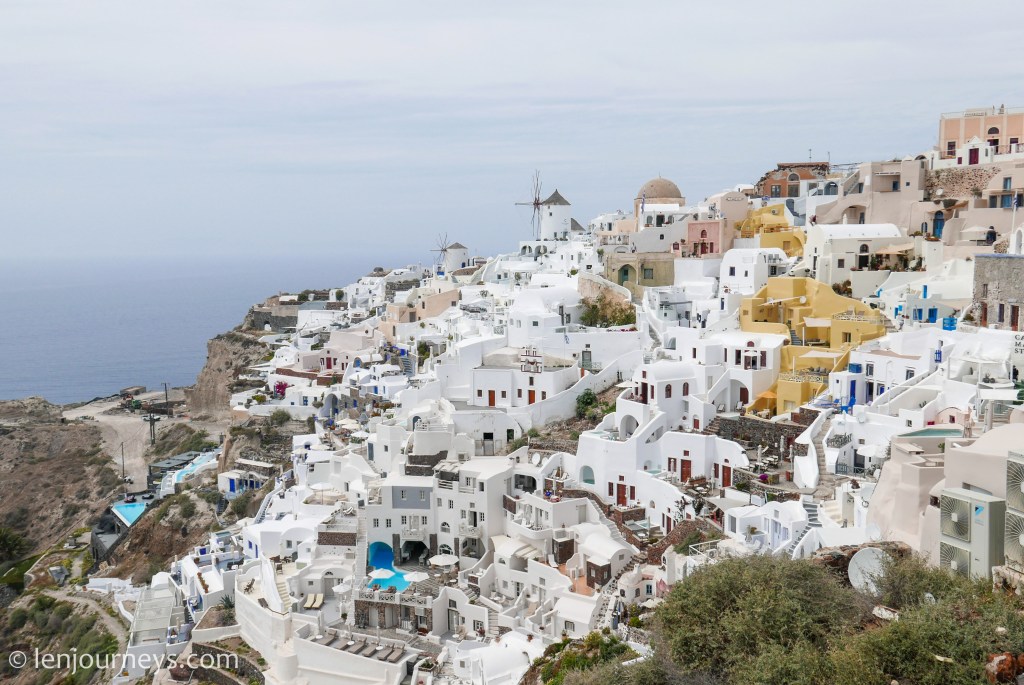
Oia, also known as Pano Meria, is the poster child of Santorini, if not, the whole of the Cyclades. Its name epitomizes cubical buildings cascading down the caldera slope and mesmerizing sunsets with the sky painted in an array of colors. But unlike many people think, the village is not pristine white. In truth, it’s a synthesis of blue-domed churches with houses in white, earthy pink, and ocher, composing a beautiful canvas that is difficult to put into words. Many have been converted into luxury hotels, restaurants, shops, and galleries.
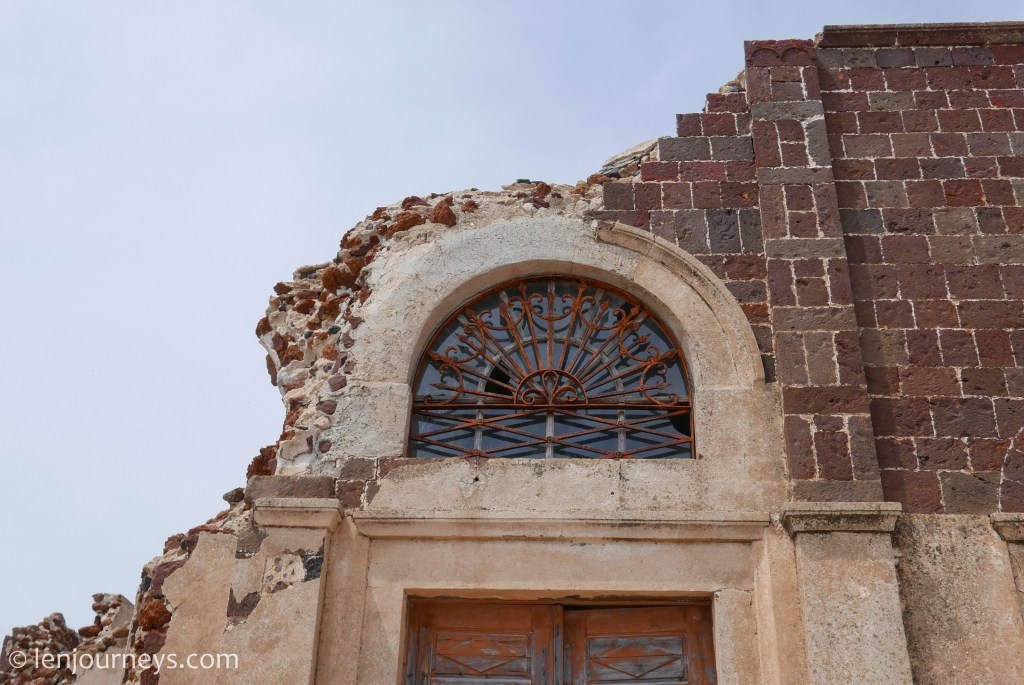
At the northwestern edge of the village stands the ruin of another Venetian fortress, the Castle of Oia. It was built in the late 15th century to guard Santorini against pirate raids. Unfortunately, it shared the same fate as Skaros Fortress and suffered destruction due to the 1950 eruption. What still stands today are parts of the watchtower and the exterior wall made of lava stones and bricks of volcanic origin. Despite that, the site is still hugely popular, because it’s believed to have the most astonishing sunset on the island.


Tips for visiting Santorini
- The total length of the caldera walk is under 10.5 kilometers (one way), with elevations ranging from 270 meters (Fira), 350 meters (Imerovigli), to 130 meters (Oia). Please note that the section from Fira to Imerovigli is short and steep, while from Imerovigli to Oia is long and gradual.
- The walking route is similar to a sidewalk, consisting of cobblestone and dirt paths. And there is little to no shade. Therefore, it’s best to start early, especially in summer.
- As you can expect, the streets around Oia and Fira are very crowded. Congestions occur frequently, in particular in the area around the Castle of Oia. Meanwhile, you can easily walk through the streets of Firostefani and Imerovigli.
- Photographs might lead you to believe that Oia is the best place to watch the sunset in Santorini. But in my humble opinion, it looks magnificent wherever you are along the caldera. Just choose somewhere close to your accommodation and enjoy your meal or drink while gazing at the remarkable scenery.
- Nevertheless, if you want to share the magic moment with thousands of strangers, Oia is the place to go. You will be shoulder to shoulder with others in a sunset “party”. It’s wise to arrive there at least two to three hours before sunset to get a place.
Recommended Stay
Converted from an 18th-century villa once belonging to a sea captain, the Tsitouras Collection offers a unique stay in Firostefani. It consists of five distinctive Cycladic suites, all with vaulted ceilings, sophisticated decor, and numerous antique artworks. The only natural light comes from the front door and windows, yet the overall color scheme is bright and cheerful, ranging from canary yellow, and solid pastel blue, to marshmallow pink.
A white wooden door opens onto a lovely shared patio, where guests can enjoy stellar views under an olive tree – there is hardly anything more Greek than that. It’s also here that the à la carte breakfast is served every morning. However, guests can opt to have the meal in the suite for more privacy. The boutique hotel is also one of the few family-friendly accommodations built along the Santorini’s caldera, offering baby cots and personalized service.
Cycladic architecture meets the old time’s charm.
Upstairs, there is an infinity pool that faces toward the volcanos. It seems to float in the sky and boasts a magnificent view over the crescent-shaped caldera. Right next to the hotel is the unmistakable Church of St. Mark with a crown-like bell tower. Additionally, due to the historic nature of the property, there is no eatery on site. But the staff are more than willing to recommend and arrange a table for you at a nearby local restaurant.


DISCLAIMER:
My recommendation is written based on my personal experience. It was neither sponsored nor solicited by the Tsitouras Collection or any third party. All texts and pictures reflect my opinions and are provided solely for informational purposes. I will not be liable for errors or damages using this information.


Santorini is a beautiful place to visit. Thank you for sharing the information.
I’m glad that you like the post, Nana 🙂
Oh my, what stunning photos Len! All the white and the blues – simply magical! I need to get myself here!
It’s truly out of this world! Thanks for visiting, Anna 🙂
Sucha fresh take on Santorini and brilliant recommendations. Beautiful photos too! Thank you
Thanks for the kind words, Nic! 🙂
Beautiful photos Len. This post brought back memories of our time there. We also did the walk from Fira to Oia. It was definitely a highlight for us.
Alison
A stunning walk, isn’t it 🙂 Did you also hike to the inland villages, Alison? Personally, I think the route is not difficult but it’s not a walk in the park.
No, we didn’t hike to the inland villages, though we did do that on Nazos. I agree the Fira-Oia trail is more than a walk in the park, but not that difficult. We enjoyed it for sure.
The whitewashed houses with blue domes, some adorned with green foliage, against the backdrop of azure skies and the Mediterranean Sea make a quintessential postcard picture of Santorini. It’s just amazing that such a place exists. But what is more incredible is the fact that there are people living along this collapsed caldera. It looks and sounds like you had an unforgettable stay on the island!
Thanks, Bama! 🙂 I’m glad that I’ve seen the Batur Caldera before. Otherwise, I couldn’t imagine how Santorini Caldera really looks like and how it was formed.